
Four Markets, One Master Variable: Gold, Oil, ES and NQ on June 24, 2026
Today is the kind of session that exposes traders who watch markets in isolation. Gold is collapsing, crude is breaking down, and the index futures are whipsawing — and it is tempting to treat those as three separate stories. They are not. One variable is doing most of the heavy lifting across all of them, and if you trade futures, recognizing it is worth more than any single price target.
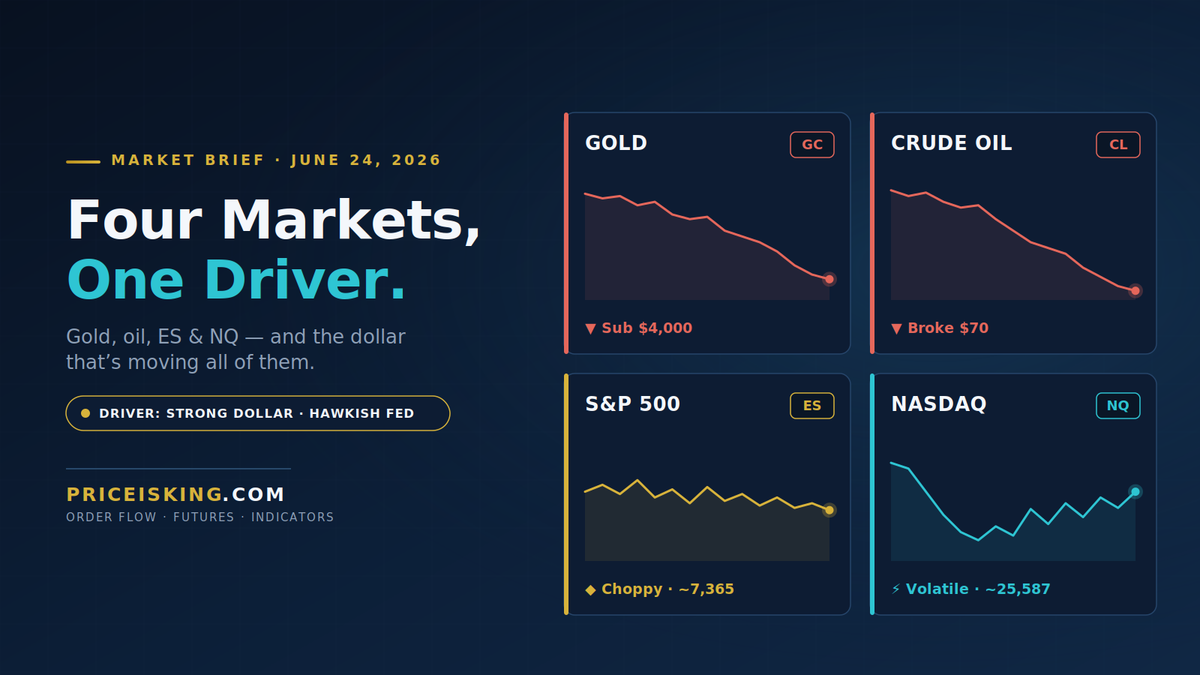
Sub-$4,000 · lowest since Nov '25
Broke $70 · ~40% off war peak
~7,365 · choppy, two-way
~25,587 · tech-led volatility
The spine: a hawkish Fed and a runaway dollar
Start with the one thing every other move is bending around. The Federal Reserve, now led by Chair Kevin Warsh, has pivoted decisively hawkish. Where policymakers had penciled in a rate cut for 2026 back in the spring, the most recent meeting flagged the possibility of a rate hike later this year, and Warsh pointedly dropped the forward guidance markets had leaned on for years. Inflation has climbed to its highest in three years, fueled largely by the energy spike from the Middle East conflict, and a firmer labor market gives the Fed cover to stay tight.
The market has taken the hint. Odds of a September rate hike have jumped to roughly two-in-three, up from less than a third just a week ago, and the US dollar index has rallied to a 13-month high. That last point is the key. A surging dollar and rising rate expectations are the mechanical force pressing down on gold and oil simultaneously — both are priced in dollars, and both compete with the yield you can now earn just sitting in cash. When the dollar runs and real yields rise, dollar-denominated assets that pay no interest are swimming upstream. Keep that lens on as we go market by market.
Gold: the safe-haven that didn't save anyone
Gold tumbled more than 3% to slip below $4,000 an ounce, its lowest level since November 2025. Step back and the damage is sharper than one day suggests: the metal has shed roughly 12% over the past four weeks and now sits about 20% below the record high it printed in January, before the Iran conflict erupted. It is down on the year despite a backdrop — war, inflation, geopolitical chaos — that textbook narratives say should send gold soaring.
That disconnect is the lesson. Gold's problem isn't fear; it's the dollar and the Fed. With a hawkish central bank lifting the opportunity cost of holding a non-yielding asset, and the dollar at multi-month highs, the monetary headwind has overwhelmed the safe-haven bid. Notice what this means for a futures trader: the popular "buy gold because the world is on fire" thesis has been a losing trade for months. Price didn't care about the story — it followed rate expectations and the dollar. If you traded the narrative, you bled. If you traded the tape and respected the trend, you stayed on the right side.
Oil: a risk premium evaporating in real time
Crude broke decisively under $70, with WTI touching a session low near $69.63 — the first sub-$70 print since early March — and now trading roughly 40% below its wartime peak. Brent has followed in lockstep. The driver here is the opposite of gold's: where bullion is reacting to monetary policy, oil is repricing geopolitics.
Tankers are once again moving through the Strait of Hormuz under maritime safety assurances, US–Iran peace talks have advanced to a 14-point draft memorandum the two sides aim to formalize this week, and a fresh 60-day US waiver now lets global buyers, including American refiners, purchase Iranian crude. The fear premium that inflated prices for months is draining out fast. There is a genuine counterweight — Cushing inventories have fallen to their lowest since 1984, brushing operational minimums — but that physical tightness is being steamrolled by the supply-normalization narrative and a strong dollar, with technicals flashing firm sell signals.
ES and NQ: caught in the crossfire
The index complex is the most interesting tape of the four, because it's being pulled in two directions at once. Tuesday delivered a brutal tech-led selloff — the Nasdaq Composite dropped 2.21% and the S&P 500 fell 1.44% — sparked by a global semiconductor rout that saw South Korea's KOSPI plunge nearly 10% on memory-chip fears and broad anxiety that hyperscaler AI spending may not pay off as fast as hoped. Today the tape is bouncing unevenly, with Micron's earnings after the close shaping up as the single most important catalyst of the week for the AI-memory group.
Here's the tension a futures trader has to hold in mind. The collapse in oil is disinflationary — in a vacuum that's a tailwind for equities, because it eases the very price pressure pushing the Fed toward hikes. But the Fed is still leaning hawkish on a firm labor market, the dollar is at highs, and tech has its own idiosyncratic problem in AI-capex and chip-supply worries. So ES (the broader S&P) and NQ (the tech-heavy Nasdaq) are not moving together cleanly. NQ is carrying far more single-sector risk right now; its swings are wider and more headline-driven, while ES is steadier thanks to the roughly 60% of its constituents outside the tech blowup. If you trade both, that spread in behavior is the opportunity — and the trap if you size them as if they were the same instrument.
What to actually do with this
The takeaway isn't a prediction. It's a hierarchy. On a day like today, the dollar and the rate path sit at the top of the food chain, and almost everything else is downstream. Before you read a gold breakdown or an oil bounce as a clean technical signal, check what the dollar and the September-hike odds are doing — because that's the current actually moving the water.
Three practical notes for the session. First, respect elevated volatility across all four; your normal stop distances may be too tight when the dollar is trending and headlines are live. Second, don't assume yesterday's correlations hold — regimes shift, and right now the macro driver is overwhelming the usual relationships. Third, let the instrument confirm. A falling oil price and a falling gold price look identical on a heat map and mean completely different things underneath. Your edge isn't guessing which narrative wins; it's reading order flow, delta, and absorption in the contract you actually trade and letting price tip its hand before you commit.
That's the entire PriceIsKing approach distilled into a single volatile Wednesday: mechanics over hype. The traders who navigate days like this aren't the ones with the loudest macro opinion. They're the ones who know which variable is in charge, who refuse to confuse a coincidence for a correlation, and who let the tape — not the headline — make the final call.
This article is for educational purposes only and is not financial, investment, or trading advice. Prices and levels referenced are intraday and approximate as of June 24, 2026, and will change. Futures trading carries substantial risk of loss and is not suitable for every investor. Do your own research and consult a licensed professional before making any trading decision.