
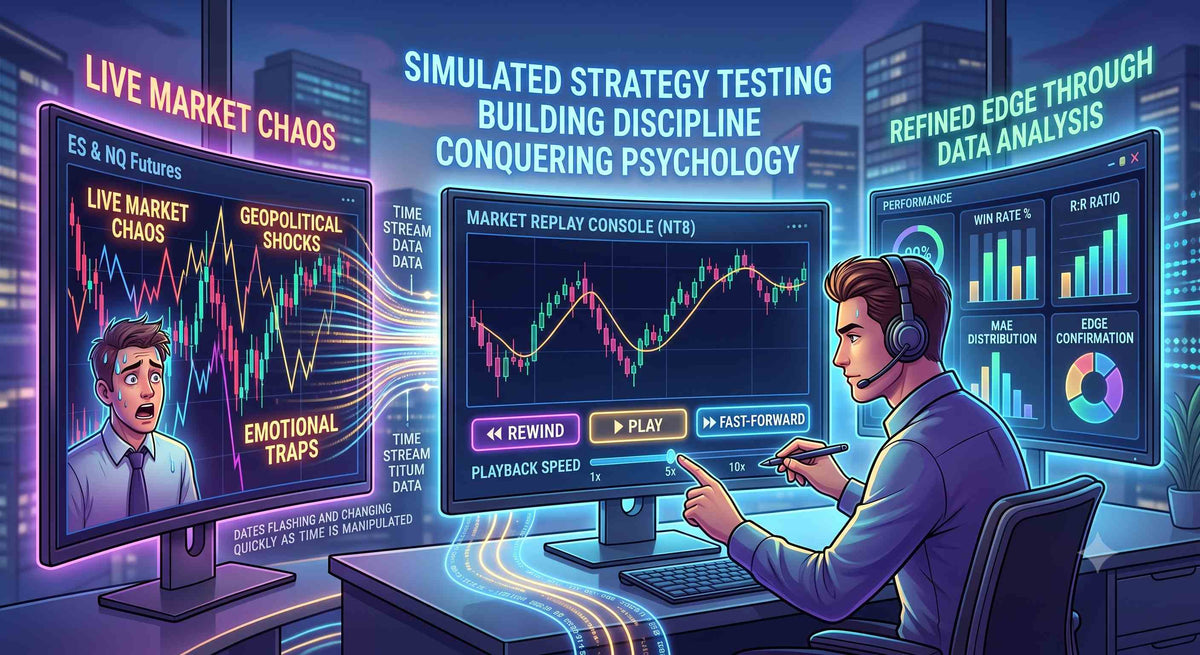
Welcome to Thursday, July 9, 2026. If you logged into your brokerage account this morning hoping for a calm, rational market environment, you clearly haven't been paying attention to the news. We are currently watching the US and Iran exchange fresh attacks in the Middle East. That massive geopolitical spark sent WTI crude oil surging 6.25% to US$74.76/bbl, while the Dow Jones took a heavy 1.09% nosedive. Interestingly enough, the Nasdaq edged 0.20% higher, just to make sure anyone trying to trade standard intermarket correlations got a massive, confusing headache. If you tried to trade these headline-driven swings with real money using a strategy you "kind of sort of" thought about in the shower this morning, your account is probably on life support right now. Day trading futures during this kind of intense volatility without rigorous, historical backtesting is basically a charitable donation to institutional algorithms. This is where market replay data stops being a neat little feature and becomes an absolute necessity for your survival.
Quick Answer Market replay allows futures traders to download historical Level 1 and Level 2 data to simulate live trading environments on weekends or after hours. By testing strategies against actual past price action, traders can build edge, refine execution, and conquer psychological hurdles without risking a single dollar of live capital.
Why is testing in a live market a terrible idea for new futures traders?
Learning to day trade futures with live capital is like trying to learn how to juggle using running chainsaws—you might figure it out eventually, but you are going to lose a few limbs in the process. Futures markets are highly leveraged, incredibly fast, and ruthlessly efficient. When you click "buy" on an E-mini S&P 500 (ES) contract, you aren't playing against other confused retail traders; you are stepping into a coliseum with high-frequency trading firms, institutional hedgers, and algorithmic market makers.
When you are developing a new strategy, you are going to make mistakes. You will misread the trend, you will place your stop-loss in an obvious liquidity pool, and you will undoubtedly revenge-trade when things go wrong. Doing this in a live market environment means every single learning moment costs you hundreds, if not thousands, of dollars. It creates a toxic feedback loop where the financial pain of losing prevents you from objectively analyzing your strategy. You start trading your PnL instead of trading the chart. To build a robust trading edge, you must separate the learning phase from the financial risk phase.
What exactly is market replay data and how does it differ from paper trading?
A lot of traders confuse market replay with standard paper trading, but they are entirely different tools. Paper trading allows you to trade fake money in a live, real-time market. The problem with paper trading is that it respects the clock. If you want to practice trading the New York open, you physically have to be sitting at your desk at 9:30 AM EST. If the market spends three hours chopping sideways in a tight range, you have to sit there and stare at it in real-time.
Market replay, on the other hand, is a time machine. Brokerages record the exact tick-by-tick data, including the Level 2 order book depth, of previous trading sessions. You can download this data and play it back on your charting platform whenever you want. Want to practice trading the volatile Nasdaq (NQ) open on a Saturday night with a beer in your hand? You can do that. Furthermore, market replay comes with a fast-forward button. You can speed through the boring, low-volume lunch hours at 10x speed and slow it back down to normal speed when your specific setup aligns. It compresses months of screen time into a single weekend.
How can market replay prepare you for major geopolitical news events?
Let's look back at today's action. The US and Iran exchanged fresh attacks in the Middle East, which caused a violent, instantaneous reaction across global assets. WTI crude oil surged 6.25% to US$74.76/bbl. The Dow Jones fell 1.09%. If you were caught on the wrong side of that momentum shift, your stops were likely bypassed, and you experienced brutal slippage.
If you survived the day but want to figure out how to trade that specific environment better next time, market replay is your best friend. Tomorrow, you can download today’s exact market data. You can rewind the tape to the exact minute the headline dropped. You can watch how the order book thinned out. You can analyze how the algorithms swept the highs before aggressively marking down the Dow. By replaying these high-stress events in a controlled environment, you learn to identify the institutional footprints that precede a massive news-driven liquidity run, ensuring you are never caught off guard again.
Why is NinjaTrader 8 the gold standard for futures market replay?
Not all trading platforms are built the same. A lot of retail web-based brokers offer clunky replay features that only show historical 1-minute candles. That is completely useless if you are trying to read order flow or trade tick charts. If you want to simulate a professional trading desk, you need software designed specifically for heavy-duty futures data.
This is why NinjaTrader 8 is universally considered the gold standard for futures replay. NT8 has a native Playback Connection that allows you to download historical Level 1 (tick data) and Level 2 (market depth) data directly from their servers. When you run a replay session on NT8, your custom indicators, your Renko bars, and your DOM (Depth of Market) act exactly as they would in a live environment. You can place simulated limit orders, practice managing trailing stops, and measure your exact fill latency. It is the closest thing you can get to a flight simulator for day trading.
How does market replay build psychological resilience?
The technical aspect of trading—drawing lines, identifying support, reading moving averages—makes up maybe 20% of the job. The other 80% is pure, unadulterated psychology. When you are in a live trade and the market suddenly spikes against you, your brain literally releases cortisol, triggering a "fight or flight" response. This is why you constantly close winning trades too early out of fear, or hold onto losing trades hoping they will turn around.
Market replay acts as exposure therapy. By putting yourself in simulated, high-stress trading scenarios over and over again, you desensitize your brain to the flashing lights of the DOM. You learn that a 15-tick pullback is just normal market breathing, not an apocalyptic reversal. You build the muscle memory required to execute your trading plan flawlessly, so when the real money is on the line, you operate out of cold, calculated logic rather than frantic emotion.
How to structure a proper market replay testing session (without getting bored)?
Just firing up a replay session and clicking buttons randomly won't make you a better trader. To extract actual value from historical data, you need a structured workflow. Here is a foolproof guide to running a professional replay session:
- Define Your Variables: Don't look for ten different setups at once. Pick one specific strategy—for example, an Opening Range Breakout (ORB) on the Nasdaq.
- Blind the Right Side: Never look at the historical chart of the day you are about to replay before you start. If you know the day closes green, your brain will subconsciously look for long setups. You must be completely blind to the outcome.
- Utilize the Fast-Forward: The market spends a lot of time doing absolutely nothing. Don't waste your weekend watching sideways chop. Fast-forward at 5x or 10x speed until the price approaches your defined areas of interest, then drop it back to 1x speed to execute.
- Treat It Like Live Capital: If you get stopped out, don't hit the "rewind" button and pretend it didn't happen. Take the loss on the chin. If you cheat in replay, you are just training yourself to be a loser in the live market.
What metrics should you track during a replay session to prove your edge?
A replay session is utterly useless if you don't track the data. You aren't just practicing clicking a mouse; you are acting as a data scientist trying to prove a mathematical hypothesis.
During your simulated trading, you need to track several key performance indicators. First, your Win Rate—out of 100 simulated setups, how many hit your target? Second, your Risk-to-Reward Ratio—are your winners consistently larger than your losers? And finally, you must track Maximum Adverse Excursion (MAE), which measures how far a trade went against you before eventually hitting your target. If you notice your MAE is consistently 20 ticks, but your stop-loss is rigidly set at 15 ticks, the replay data just proved that your stop-loss placement is structurally flawed. Fix it in the simulator so you don't have to bleed out your live account to figure it out.
Frequently Asked Questions
What is market replay in futures trading?
Market replay is a feature provided by advanced trading platforms that allows you to download historical market data and play it back as if it were happening in real-time. This lets traders practice their strategies and execution on actual past price action without risking real capital.
Does market replay use real historical data?
Yes, true market replay uses exact tick-by-tick historical data recorded directly from the exchange. It includes the precise price movements, volume, and often the Level 2 order book depth that occurred on that specific day in the past.
What is the difference between paper trading and market replay?
Paper trading involves trading fake money in current, live market conditions, meaning you must trade during actual market hours. Market replay allows you to trade historical data at any time (like on a weekend) and gives you the ability to pause, rewind, or fast-forward the price action.
How do I get market replay data on NinjaTrader 8?
In NinjaTrader 8, you disconnect from your live or simulated data feed and connect to the "Playback Connection." From there, you can download historical replay data for specific instruments and dates directly from the NinjaTrader servers to begin your testing session.
Can market replay help with trading psychology?
Absolutely. Market replay functions as exposure therapy. By repeatedly executing your trading plan in a simulated, high-speed environment, you build muscle memory and desensitize yourself to the emotional stress of watching prices fluctuate, which translates to calmer live trading.
Is market replay accurate for Level 2 order flow?
High-quality platforms like NinjaTrader 8 provide Level 2 market depth data in their replay files. However, you must remember that your simulated orders will not impact the historical order book, so you won't experience live-market slippage in the exact same way.