
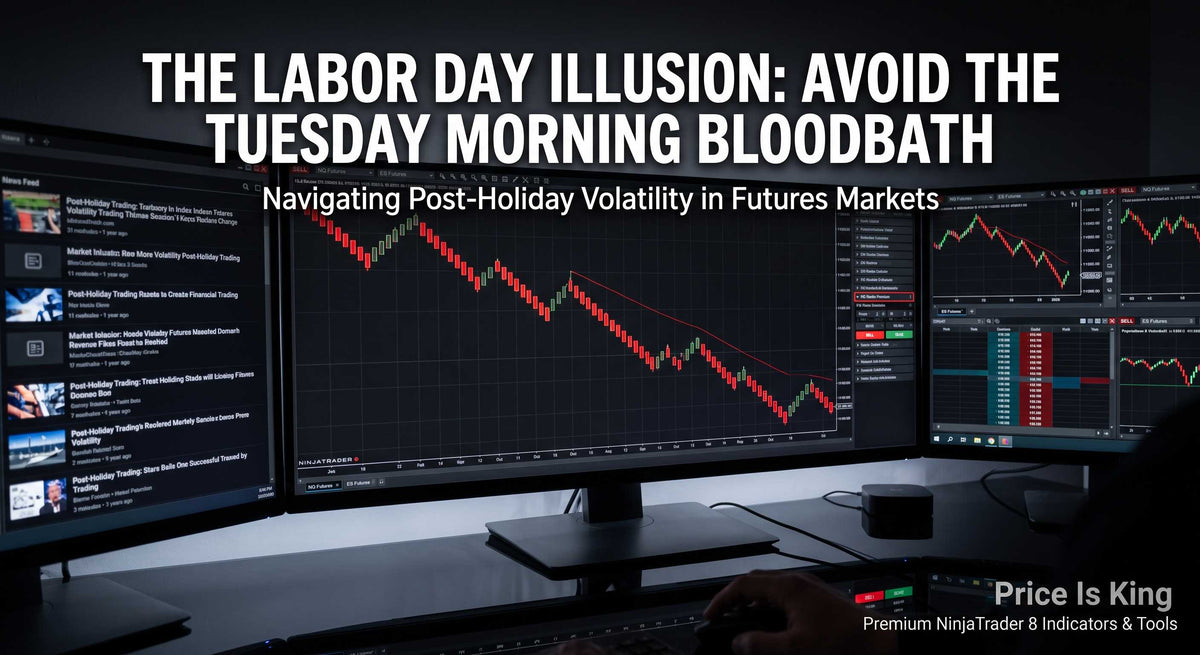
Happy Labor Day. It is Monday, September 7, 2026. The U.S. markets are closed, your brokerage app is peacefully frozen, and hopefully, you are outside enjoying a barbecue instead of staring at a dead NinjaTrader DOM. But while you are flipping burgers and celebrating the end of summer, a massive, invisible shift is occurring across the global financial landscape. For the last eight weeks, you have been trading in a "Summer Market"—a low-volume, low-liquidity environment where senior institutional portfolio managers were vacationing in the Hamptons and leaving their junior analysts to babysit the algorithms. Tomorrow morning, that all ends. On the Tuesday following Labor Day, Wall Street officially returns to the office. The massive institutional block orders that have been sidelined since July are about to be unleashed back into the order book. If you log into your platform tomorrow morning expecting the same slow, grinding 15-point E-mini Nasdaq ranges you saw in August, you are walking directly into a financial woodchipper. Welcome to the Labor Day Illusion, where amateur traders accidentally donate their entire summer profits to returning hedge funds before 10:00 AM.
Quick Answer The Tuesday after Labor Day marks the abrupt return of massive institutional trading volume. This influx of capital instantly widens the Average True Range (ATR) and creates violent algorithmic volatility. Retail traders who fail to mathematically reduce their position sizes to account for this expanded volatility will inevitably suffer catastrophic drawdowns right at the morning open.
The End of the Summer Lull: What actually happens on Tuesday morning?
To survive tomorrow’s opening bell, you must understand the mechanical difference between August order flow and September order flow. During the summer, liquidity is notoriously thin. Because major participants are away, high-frequency trading (HFT) algorithms dominate the tape, creating choppy, mean-reverting price action. Breakouts constantly fail, and the market spends days oscillating in tight, suffocating ranges.
When the clock strikes 9:30 AM EST tomorrow, the dynamic completely flips. Asset managers have spent the long weekend reviewing their Q4 projections, analyzing September macroeconomic data, and deciding how to reallocate billions of dollars of capital for the final stretch of the year. When these massive structural orders hit the exchange, they do not care about your little 1-minute support line. They sweep the liquidity aggressively, looking to fill massive inventory quotas.
This influx of real, directional volume causes immediate and often violent trend days. The market will pick a direction and relentlessly grind that way for six hours straight, utterly destroying anyone who tries to stubbornly fade the move or guess the top. The "Labor Day Illusion" is the deadly retail assumption that the market will behave exactly as it did last Friday. It will not. The physics of the tape have fundamentally changed.
The "Gap and Go" vs. The "Stop Hunt": How algorithms welcome you back
Because institutional desks know that retail traders are complacent after the long weekend, they frequently use the Tuesday open to engineer brutal liquidity traps. You will likely see one of two scenarios play out tomorrow morning, and both are designed to extract maximum capital from the impatient amateur.
The first scenario is the "Gap and Go." The overnight Globex session will push the NQ significantly higher or lower, opening with a massive gap. Retail traders, conditioned by summer chop, will assume the gap will immediately fill. They will aggressively fade the open. Instead of filling, the institutional volume steps in, absorbs the retail counter-trend orders, and triggers a runaway trend day. The retail trader averages down into their losing position all morning until their broker forcefully liquidates their account at noon.
The second scenario is the "Welcome Back Stop Hunt." The market opens flat, prints a massive green 5-minute candle, and convinces the retail crowd that a massive breakout is happening. Thousands of retail traders smash the market-buy button. The very millisecond the retail volume spikes, the algorithms reverse the tape, dropping the NQ 80 points in a straight line, sweeping every single retail stop-loss resting below the opening range, before calmly reversing back to the original trend. Both scenarios rely on the exact same vulnerability: a retail trader using rigid, summertime risk parameters in a high-volatility environment.
Why your August risk parameters will blow your September account
Let’s talk about the math of survival. In August, the Average True Range (ATR) of the E-mini Nasdaq might have been relatively compressed. Because the swings were smaller, you could comfortably place a 15-point stop-loss on your trade, knowing it was safely tucked behind a structural level. You could trade 3 or 4 contracts and keep your total financial risk under 1% of your account equity.
Tomorrow, that ATR is going to explode. The swings are going to be wider, the algorithmic wicks are going to be deeper, and the velocity of price movement will be twice as fast. If you use a 15-point stop-loss tomorrow, you are just providing free liquidity to the market makers. The normal "noise" of the Tuesday morning open will slice right through a tight stop before the real move even begins.
To survive this expanded volatility, you are mathematically required to widen your structural stop-loss. Your stop must be placed securely behind major volume nodes, which might now be 35 or 40 points away from your entry. But here is the lethal trap: if you widen your stop-loss from 15 points to 40 points, but you continue to trade the exact same contract size you used in August, you just inadvertently tripled your financial risk. When that trade fails—and trades will fail—you won't lose 1% of your account; you will lose 3% or 4% in a single trade. Do that twice by 10:30 AM, and your trading week is over before it even started.
The Pro Position Sizing Suite defense: Mathematically surviving the open
You cannot out-guess institutional volume, but you can mathematically insulate yourself from its chaotic side effects. If you are serious about protecting your capital tomorrow morning, you cannot eyeball your contract size. This is precisely why the Pro Position Sizing Suite for Excel is a non-negotiable tool for the post-holiday transition.
Before you take a single trade on Tuesday, you must open the spreadsheet. You input your total account equity and enforce your strict 1% maximum risk limit. You look at the violent morning chart, identify the true structural invalidation point (which will be much wider than last week), and type that distance into the Excel suite.
The spreadsheet will instantly run the calculus on the expanded volatility and force a reality check on your ego. Because your stop-loss is necessarily wider, the Pro Position Sizing Suite will aggressively throttle down your contract size. It will clearly show you that to maintain your 1% risk profile with a 40-point stop, you can no longer afford to trade standard E-mini contracts. It will explicitly instruct you to step down to the Micro contracts (MNQ) and will give you the exact quantity allowed.
This is how professionals trade. They do not fight the volatility; they mathematically scale into it. By using the spreadsheet to dynamically adjust your leverage relative to the expanded ATR, you guarantee that even if the returning Wall Street algorithms hit your stop-loss on a wild sweep, the damage to your account remains an insignificant paper cut.
Building a defensive Tuesday morning routine
Tomorrow is not the day to be a hero. Tomorrow is the day to be a sniper. The optimal way to handle the post-Labor Day open is to do absolutely nothing for the first hour of the session.
From 9:30 AM to 10:30 AM, let the returning institutional capital violently fight it out. Let the massive block orders collide, let the retail stops get hunted, and let the initial balance expand. Do not put a single cent of your hard-earned capital at risk during this preliminary phase of price discovery. Let the dust settle.
Once the first hour is complete, the true institutional intent for the month of September will be painted clearly on the chart. You will see exactly where the volume is anchored and which direction the smart money is heavily sponsoring. Only then do you look for a high-probability confluence pullback. Only then do you run the parameters through your Excel suite. Keep your size small, keep your stops wide, and let the institutions do the heavy lifting for you. Welcome back to the real market.
Frequently Asked Questions
Why is the Tuesday after Labor Day so volatile?
Labor Day marks the unofficial end of summer on Wall Street. Institutional portfolio managers, hedge funds, and major trading desks return to full staffing levels. This causes a sudden, massive influx of real volume and large structural block orders entering the market, drastically increasing volatility compared to the quiet weeks of August.
What is Average True Range (ATR) and how does it change after a holiday?
ATR is a technical indicator that measures market volatility by decomposing the entire range of an asset price for a given period. After Labor Day, as institutional volume returns, the ATR typically expands significantly, meaning the average distance a stock or index moves in a single candle or session becomes much wider.
Why do my normal stop-losses get hunted on high-volume days?
When volume increases, the algorithmic wicks that test liquidity zones become deeper. If you use a tight, fixed-point stop-loss (like you would in a low-volume summer market), normal price action noise will hit your stop before the actual directional move occurs. Stops must be widened and placed behind structural volume nodes to survive this environment.
How does the Pro Position Sizing Suite handle expanded volatility?
When you widen your stop-loss to survive the post-holiday volatility, the Excel suite automatically recalculates your maximum allowable contract size against your strict 1% account risk limit. It forces you to mathematically scale down your leverage (e.g., trading micros instead of e-minis) so that a wider stop does not result in a larger financial loss.
What is a "Gap and Go" setup?
A "Gap and Go" occurs when an asset opens significantly higher or lower than its previous close and immediately continues trending aggressively in the direction of the gap without pulling back to fill it. It is heavily driven by institutional volume overwhelming any contrarian retail traders trying to fade the move.
Should I day trade the market open right after a long weekend?
It is highly advised for retail traders to wait at least 30 to 60 minutes after the opening bell following a long holiday weekend. This allows the initial burst of chaotic algorithmic rebalancing and stop-hunting to conclude, providing a clearer picture of the true structural trend for the day.