
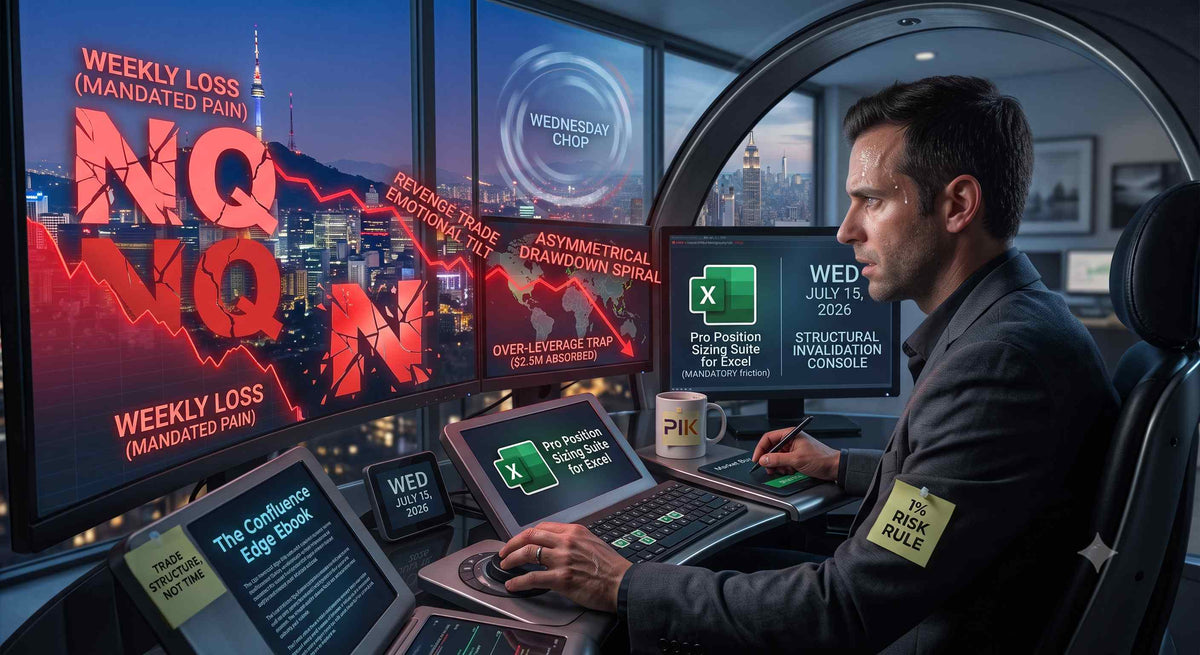
It is Wednesday, July 15, 2026, and we need to have a very uncomfortable conversation about your Profit and Loss statement. On Monday, the Nasdaq plummeted over 400 points thanks to the global semiconductor meltdown, likely catching you off guard if you were blindly buying the dip. On Tuesday, JPMorgan’s massive earnings beat triggered a vicious algorithmic "sell the news" whiplash that probably chopped out whatever capital you had left. Now, it is Wednesday morning. You are staring at a deeply red weekly PnL, your ego is bruised, and your heart rate is elevated. The little voice in the back of your head is telling you to double your contract size on the E-mini S&P 500 today, skip the stop-loss, and just "win it all back" in one glorious, heroic trade. Stop right there. Take your hand off the mouse. You are currently experiencing the psychological phenomenon known as the "tilt," and if you click that buy button, you are about to voluntarily throw your entire account balance into a financial woodchipper.
Quick Answer Revenge trading is the emotional, impulsive act of aggressively over-leveraging a position to immediately recover recent financial losses. It mathematically guarantees long-term bankruptcy. To survive, day traders must implement a strict mechanical circuit breaker—like an Excel position sizing suite—to force logical risk limits and override emotional tilt.
What exactly is a revenge trade and why does it feel so intoxicating?
To fix a revenge trading problem, you first have to understand that it is not a financial issue; it is a neurological one. When you experience an unexpected financial loss—especially a painful, unfair-feeling loss like a stop-hunt during Tuesday's earnings chop—your brain registers it as a physical threat. Your amygdala takes over, flooding your body with cortisol and adrenaline. The logical, calculating part of your prefrontal cortex essentially unplugs itself.
In this heightened emotional state, the market ceases to be a matrix of probabilities and structural order flow. Instead, it becomes a personal enemy that just stole your wallet. The revenge trade is the immediate, visceral response to that theft. You double your standard contract size because your brain is demanding instant gratification and dopamine to offset the pain of the loss. It feels incredibly intoxicating in the five seconds before you execute the trade because you are feeding an addiction. But the market does not care about your feelings, your rent payment, or your bruised ego. It is a cold, sociopathic pricing engine, and it will happily take your doubled-up position and liquidate it without a second thought.
The anatomy of a Wednesday wipeout following a brutal Monday
There is a very specific reason why Wednesdays are statistically catastrophic for amateur retail traders. Mondays and Tuesdays often dictate the narrative of the week. If a trader suffers back-to-back losses during the early week volatility (like the SK Hynix crash and the JPM earnings trap), Wednesday becomes the psychological breaking point.
By Wednesday morning, the institutional volume usually drops. The big macroeconomic moves have been priced in, and the market enters a slow, rotational, algorithmic chop. This is the absolute worst possible environment for a desperate retail trader. A revenge trader needs a massive, trending directional move to bail out their over-leveraged position. Instead, they get a 15-point sideways range on the NQ.
They buy the top of the range, assuming a breakout. It immediately reverses. They flip short at the bottom of the range, assuming a breakdown. It immediately reverses again. Because they are trading double or triple their normal size to "win back Monday," these small 10-point paper cuts inflict catastrophic damage on their account equity. What started as a completely manageable 3% drawdown on Monday metastasizes into a 40% account blowout by Wednesday lunchtime.
Why do retail trading platforms secretly want you to revenge trade?
Have you ever noticed how easy it is to enter a trade on a modern retail brokerage app? You literally just swipe right, or click a massive, glowing green button. There is confetti. There are flashing lights. The entire user interface is specifically engineered by UI/UX psychologists to remove all friction between your emotions and your capital.
Brokerages make money on payment for order flow (PFOF) or commissions. They do not make money when you patiently sit on your hands for three days waiting for a high-probability confluence setup. They make money when you lose your temper, smash the market-buy button twelve times in ten minutes, and churn your account to death. The gamification of trading platforms is the single biggest enabler of the revenge trade epidemic. If your platform makes it easy to act on anger, you are bringing a loaded gun to a bar fight.
How the Pro Position Sizing Suite for Excel acts as your financial circuit breaker
If you want to survive in this industry, you have to realize that you cannot trust your own brain after a loss. You must outsource your risk management to cold, unfeeling mathematics. This is why professional traders do not "eyeball" their risk; they use the Pro Position Sizing Suite for Excel.
The magic of the Excel suite isn't just the advanced calculus it performs behind the scenes; the magic is the friction it introduces into your workflow. When you are fuming mad about a stopped-out trade and want to immediately re-enter, you are not allowed to touch your trading platform. You must open the spreadsheet first.
You have to physically type in your current, reduced account balance. You have to type in your rigid 1% risk rule. You have to look at the chart, find a legitimate structural invalidation point, and type in that price. By the time you have spent forty-five seconds filling out the mandatory fields in the Pro Position Sizing Suite, your heart rate has dropped. The emotional spike has subsided. You are forced to look at the objective mathematical output, which is explicitly telling you that to maintain your risk parameters, you can only afford to buy one single Micro contract, not the five standard E-minis your ego was demanding. The spreadsheet acts as a circuit breaker, literally short-circuiting the revenge trade before it can be sent to the broker.
The mathematics of recovery: Why doubling down mathematically guarantees bankruptcy
Let’s address the fatal flaw in the "I just need to win it back" logic. Most retail traders do not understand the asymmetrical mathematics of drawdown recovery. If you take a disciplined, structured loss of 2% on a Monday, you only need to make a 2.04% gain on your remaining capital to get back to breakeven. That is one good trade.
However, if you revenge trade on a Wednesday, double your leverage, and blow a 30% hole in your account, the math turns violently against you. To recover from a 30% drawdown, you do not need a 30% gain; you need a 42.8% gain just to get back to zero. If your revenge trading tilt spirals completely out of control and you lose 50% of your account, you now need a miraculous 100% gain on your remaining capital.
By abandoning your position sizing rules to chase a quick fix, you place yourself in a mathematical prison that is almost impossible to escape. The Excel suite prevents this death spiral. It forces you to accept the 2% paper cut like a professional business expense, rather than compounding it into an unrecoverable disaster.
Building a professional post-loss routine
If you are currently sitting on a red PnL for the week, here is your mandatory, non-negotiable Wednesday playbook. Close your brokerage terminal immediately. You are legally not allowed to execute a trade while your amygdala is compromised.
Next, open your Pro Position Sizing Suite and update your equity curve. Feel the sting of the lower number, and accept it as reality. Do not try to hide it from yourself. Once your risk architecture is updated, open your charting software and review the trade that put you in the red. Did you violate your confluence rules? Did you trade a time-based chop zone instead of waiting for a structural level? Did you get baited by a news headline?
Finally, walk away. The market will be here tomorrow. It will be here next week. There will be another massive earnings release, another geopolitical oil spike, and another tech rotation. You do not have to conquer the Nasdaq today. A professional trader’s primary job is not making money; it is ruthlessly protecting capital so that when the perfect, high-probability setup finally aligns, you have the financial ammunition required to execute it. Stop fighting the tape, respect the spreadsheet, and live to trade another day.
Frequently Asked Questions
What defines a "revenge trade" in day trading?
A revenge trade is an impulsive, emotion-driven execution taken immediately after a painful loss. It typically involves abandoning your trading plan, removing stop-losses, and dramatically increasing your position size in a desperate, ego-driven attempt to win the lost money back in a single move.
Why is revenge trading so dangerous to an account balance?
It creates an asymmetrical drawdown spiral. Because revenge trades usually involve excessive leverage and poor structural setups, they frequently result in massive compounding losses. Due to the math of drawdowns, recovering from a 50% account loss requires a 100% gain just to reach breakeven.
How does the Pro Position Sizing Suite for Excel prevent emotional trading?
The Excel suite acts as a psychological circuit breaker. It forces you to manually type in your equity, define your risk percentage, and calculate your exact structural stop-loss before execution. This required physical and mental friction forces the logical part of your brain to re-engage, often preventing the impulsive trade entirely.
What should I do immediately after taking a painful stop-loss?
The best professional practice is to step away from the trading terminal for at least 15 to 30 minutes. You must allow your cortisol and adrenaline levels to drop, update your risk management spreadsheet to reflect the new account balance, and objectively review why the trade failed before taking any further action.
Why are Wednesdays historically dangerous for retail day traders?
If a trader suffers losses during the high-impact macroeconomic events or corporate earnings that often occur on Mondays and Tuesdays, Wednesday becomes a psychological breaking point. As institutional volume drops and the market chops sideways, desperate retail traders over-leverage to force a recovery, getting chewed up by the algorithms.
Can a broker platform make revenge trading worse?
Yes. Many modern retail brokerage apps are highly gamified with one-click executions and flashy UI designs. By removing the friction between the trader's emotional impulse and the actual market order, these platforms actively encourage overtrading and immediate, thoughtless execution.