
Search "the 84% rule in trading" and you will find dozens of YouTube videos and blog posts promising that a single re-entry trick lets you win 84% of the time. Before you build a strategy around that number, you deserve the truth about where it comes from — and the genuinely useful market mechanic hiding underneath the hype.
The short version: the "84%" is not a backtested statistic. There is no published dataset, no academic paper, and no broker study that produces the figure. It is a memorable label that trading educators attached to a real, time-tested concept — the failed-breakout re-entry. That concept is worth understanding deeply, especially if you trade fast index futures like the E-mini Nasdaq (NQ), Micro Nasdaq (MNQ), or E-mini S&P 500 (ES). This guide breaks down what the rule actually claims, why the underlying logic works, and how to apply it without fooling yourself with a made-up win rate.
What Does the 84% Rule Actually Say?
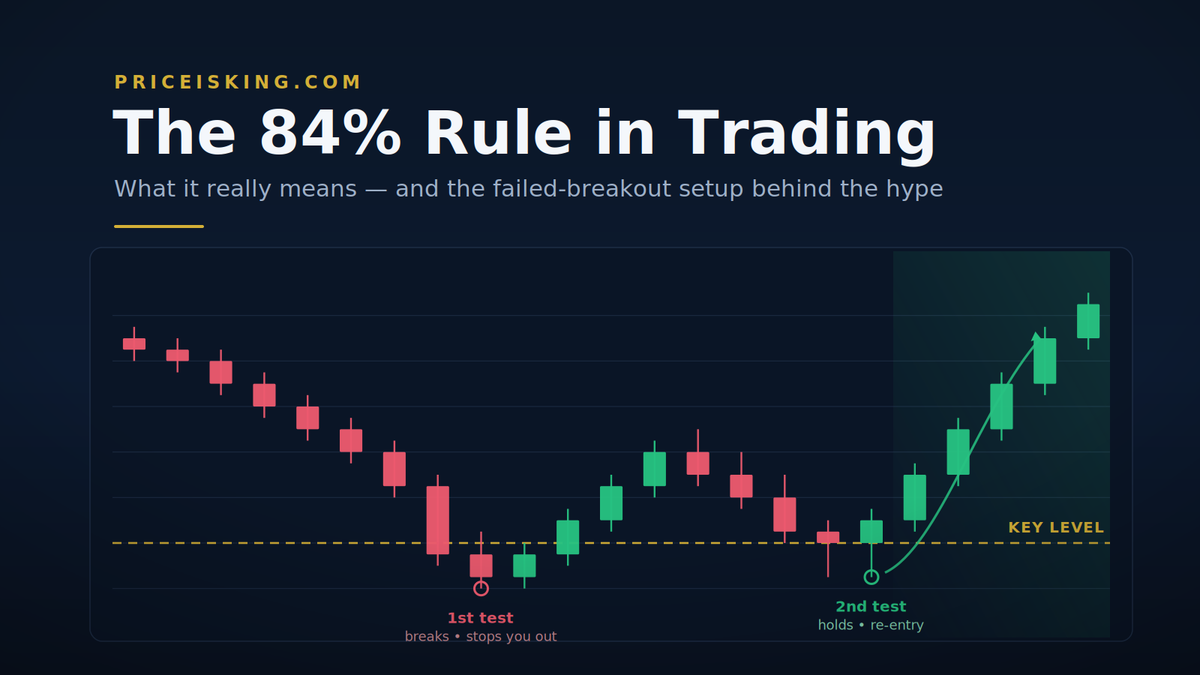
Stated plainly, the 84% rule goes like this: if you take a trade at a key level and it fails the first time, then price returns to that exact same level a second time — and your original thesis is still intact — the second attempt should work out roughly 84% of the time.
Picture a support level on the NQ. You buy the first bounce, and it gets stopped out. Price drifts away, then comes back to retest the same level. The rule says that second touch is the higher-probability entry, not the first. The number 84 is presented as the historical odds of that re-entry succeeding.
Notice what the rule is really describing. It is not a magic indicator or a secret formula. It is a structured opinion about retests and false breakouts — two of the most studied behaviors in price action. The packaging is new; the idea is old.
Where the "84%" Number Comes From
Here is the part most articles skip. The 84% figure traces back to retail trading educators on YouTube and Discord, not to a verified study. It spread through the day-trading community as a catchy soundbite, got repeated across SEO blogs, and eventually started to sound like an established law of the market. It is not one.
Even sources that teach the rule openly acknowledge this. It is widely described as a concept that is not a proven or standard rule, one that stems from anecdotal experience rather than measured data. That does not make it useless — plenty of profitable traders lean on failed-breakout re-entries — but it means the precise percentage should be treated as a marketing label, not a probability you can bank on.
The honest framing: Treat "84%" as a nickname for a high-probability setup, not as a guaranteed win rate. Your real edge comes from the conditions you require before taking the trade — not from a number someone put in a video title.
The Real Concept: Failed Breakouts and Second Chances
Strip away the percentage and you are left with something genuinely valuable. Markets do not move in clean lines — they probe levels, trap traders, and reverse. A failed breakout happens when price pushes through a key level just far enough to trigger orders and stops, then snaps back inside the prior range. These are among the most reliable reversal signals in technical analysis because they reveal where the crowd got positioned wrong.
The 84% rule is essentially a rule for trading the aftermath of that trap. The first attempt at a level often fails precisely because not enough participants have committed yet, or because a layer of stop orders sits just beyond it. When price returns for a second test and holds, it is telling you the level is being defended — and that the traders who were caught the first time are now fuel for the move in your direction.
Why a Second Test Can Be Higher-Probability
There are a few structural reasons the re-entry idea has merit:
- Trapped traders create fuel. When the first attempt fails, a wave of traders is now offside. As price moves against them on the second test, their forced exits (stop-outs) push price further in your favor.
- Liquidity gets cleared. The first run often "sweeps" the obvious stops sitting around a level. With that liquidity gone, the second test faces less resistance to moving cleanly.
- Confirmation reduces guesswork. A second test lets you see how price reacts to the level before you commit, rather than blindly catching the first touch. That is information the first-attempt trader never had.
- Intact structure signals control. If the broader trend or range never broke between the two attempts, the path of least resistance hasn't changed — the level is simply being retested within a structure that still favors your direction.
The Conditions That Must Hold
This is where most people misuse the rule. They hear "re-enter after a stop-out" and turn it into revenge trading — stubbornly buying the same level over and over because they refuse to be wrong. That is not the 84% rule. That is the fastest way to drain a funded account.
The setup only carries an edge when specific conditions are still true on the second attempt:
- Market structure did not break. If your thesis was "uptrend holding above support," the uptrend must still be intact. The moment price makes a decisive lower low and shifts structure, the level is no longer support and the thesis is dead. Walk away.
- The level is a real level. A prior swing high/low, a session open, the prior day's value area edge, a volume node — something with genuine significance, not a random line you drew to justify a trade.
- Your original thesis is unchanged. Same reason for the trade, same direction, same context. If the news or the macro backdrop shifted between attempts, the setup is no longer the same setup.
- You see a reaction, not just a touch. Wait for price to respond to the level on the retest — a rejection wick, a shift in order flow, a slowing of momentum — before entering.
Remove any one of these and the "84%" evaporates. The edge was never in the number; it was in the discipline of only taking the trade when the structure still supported it.
How to Apply It on NQ, MNQ, and ES
Index futures are a natural home for this concept because they are liquid, level-driven, and prone to stop runs around obvious price points. Here is a practical, repeatable way to use the failed-breakout re-entry on instruments like the NQ or MES.
1. Mark your levels before the session.
Identify the levels that matter — prior day high/low, overnight range edges, the session open, and any major swing points. These are the spots where first attempts tend to fail and second tests tend to matter.
2. Let the first attempt play out.
When price first reaches your level and you take a trade that fails, do not immediately reload. Note what happened. A stop-out at a key level is data, not a personal insult.
3. Wait for the return — and the structure check.
As price comes back toward the same level, ask one question first: did market structure break in the meantime? If yes, stand down. If no, you have a candidate for the re-entry.
4. Demand a reaction at the level.
On a Micro contract (MNQ/MES) where the dollar risk is smaller, you can be slightly more flexible, but still wait for price to show rejection — a wick, an absorption of selling, a momentum stall — before entering. Don't anticipate; respond.
5. Define risk to invalidation, not to a feeling.
Your stop belongs on the other side of the level where the setup would be objectively wrong — beyond the structure point, not at an arbitrary tick count. If price closes through there, the thesis is broken and you are out.
6. Aim for an asymmetric payout.
Because you are entering closer to the level on a confirmed reaction, your stop is often tight, which lets you target a 2:1 reward-to-risk or better. The math of the setup comes from that asymmetry far more than from any claimed win rate.
The 1–2% Rule still rules. No re-entry concept overrides position sizing. Risk no more than 1–2% of account equity per attempt. On a $10,000 funded evaluation, that caps a single trade's loss near $100–$200 — small enough that a string of failed first-and-second attempts can't end your run.
Where the 84% Rule Breaks Down
Every setup has an environment where it stops working. The failed-breakout re-entry is no exception, and pretending otherwise is how traders blow up. Be especially careful in these conditions:
- Strong trend days. When the NQ is trending hard in one direction, levels get sliced through and never look back. Fading a clean breakout because "the second test should hold" is a fast way to get run over.
- High-impact news. Around CPI, FOMC, or NFP, structure can reset in seconds. A level that mattered before the print may be meaningless after it. The "same thesis" condition almost never survives a major release.
- Repeated re-entries. The rule describes a second attempt, not a third, fourth, and fifth. If a level fails twice, the market is telling you something. Stacking entries is revenge trading wearing a strategy costume.
- Thin liquidity. Overnight or during low-volume sessions, price action around levels gets erratic and the trapped-trader dynamic weakens. The setup works best when there is real participation.
If you backtest the failed-breakout re-entry yourself across your own instrument and timeframe, you will almost certainly not get exactly 84%. You will get whatever your edge actually is — and that number, measured honestly on your own trades, is worth infinitely more than a figure from a video thumbnail.
Should You Use It?
Yes — as a concept, with your eyes open. The failed-breakout re-entry is a legitimate, widely-traded idea, and the discipline it forces (wait for the retest, confirm the structure, only act on a reaction) makes you a more patient trader. That patience alone improves most struggling accounts.
No — if you treat "84%" as a literal promise. The number is not measured, not guaranteed, and not yours until you've validated the setup on your own data in a simulator. Anyone selling it as a sure thing is selling you a story.
The right move is to take the genuinely useful part — the structured logic of trading second tests at defended levels — and pair it with the only things that actually keep traders alive: defined risk, strict position sizing, and a journal that tells you your real win rate.
Conclusion
The 84% rule is a catchy name wrapped around a solid idea. The name is anecdotal; the idea — that a confirmed second test of a key level, inside intact structure, is often a higher-probability entry than the first attempt — has real merit on index futures like the NQ, MNQ, and ES. The traders who profit from it aren't relying on the percentage. They're relying on the conditions, the risk control, and the patience to skip the trade when the structure breaks.
At Price is King, we'd rather hand you the truth than a number that sounds good on a thumbnail. Master the mechanics of failed breakouts and retests, enforce your stops, size every position with the 1–2% rule, and let market structure — not a viral statistic — decide when you press the button.
Disclaimer: This content is for educational purposes only and should not be considered personalized investment, financial, or legal advice. Trading futures involves substantial risk of loss and is not suitable for every investor. The "84% rule" is an anecdotal trading concept and not a verified or guaranteed statistic. Past performance is not indicative of future results. Please consult a qualified professional before making any financial decisions.