
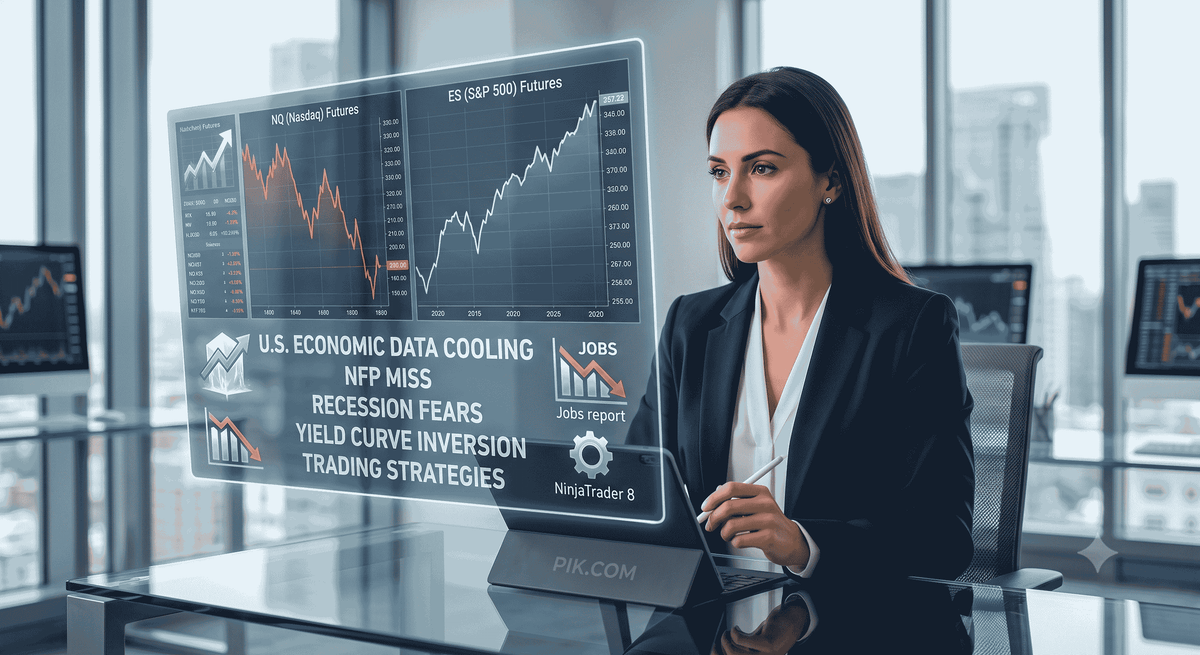
Friday’s June 2026 Non-Farm Payrolls (NFP) report just threw a massive curveball into the Q3 futures markets. With only 57,000 jobs added—well below the 113,000 forecast and a steep drop from May’s revised 129,000—we are seeing a definitive cooling in the labor market. While the headline unemployment rate dipped to 4.2%, underneath the hood, the drop was driven by a shrinking labor force rather than aggressive hiring. For futures traders, this specific cocktail of softening data and shifting rate hike expectations is sparking a massive capital rotation out of tech-heavy NQ and into the Dow (YM), creating high-probability breakout setups if you know how to filter the noise.
Quick Answer The cooling June 2026 jobs data means the Fed has more room to pause rate hikes, pushing capital out of volatile tech and into value stocks. Futures traders should anticipate choppier NQ price action and stronger trend continuations in ES and YM, relying on custom bar types to filter out false breakouts during this sector rotation.
How is the June 2026 jobs report changing market momentum?
When economic data comes in cold, institutional money doesn't just sit on the sidelines—it rotates. The immediate reaction to the 57K jobs print was a surge in the Dow to record highs, while the Nasdaq bled out due to semiconductor weakness and profit-taking in the tech sector. This divergence is the defining characteristic of early Q3 2026.
If you are trading standard time-based charts right now, you are likely getting chopped up on the NQ. The intraday swings are being driven by algorithmic repositioning rather than directional conviction. To survive this rotation, you have to stop looking at time and start looking at pure price movement.
Why are time-based charts failing in the current volatility?
In a market digesting macro news like an unexpected NFP miss, time-based candles distort the actual buying and selling pressure. A 5-minute chart will print 12 candles in an hour, regardless of whether the ES moved 20 points or 2 points. During the post-NFP chop, this creates a series of false signals, dojis, and wicks that easily trigger retail stop losses.
Traders who are consistently pulling points out of this market have moved away from time entirely. By focusing purely on price action, you eliminate the visual noise of low-liquidity institutional positioning.
How can custom indicators improve your entry accuracy?
The most effective way to trade a sector rotation is to only engage when price proves it has momentum. This is where tools built specifically for NinjaTrader 8 give you a mechanical edge.
Instead of guessing if a pullback on the NQ is a reversal or just algorithmic noise, you need a charting setup that only prints a new bar when a specific price threshold is met. When you pair this logic with the PIK Renko Premium indicator, the chop disappears. You get clean, color-coded blocks that explicitly tell you when the bulls or bears are actually in control of the tape, completely ignoring the time it took to get there.
What is the best strategy for trading the ES and NQ this quarter?
With tech wobbling and value stocks surging, your strategy needs to adapt to the asset.
For the ES (S&P 500) and YM (Dow), we are seeing sustained momentum. The strategy here is trend-following. Wait for a definitive break of the morning opening range, use a trailing stop, and let the institutional rotation carry the trade.
For the NQ (Nasdaq), the strategy must shift to mean reversion or tight scalping. Because capital is currently rotating out of tech, the NQ is prone to aggressive, sudden pullbacks. Using advanced charting tools allows you to identify the exact tick where momentum exhausts, giving you tight risk-to-reward entries on the short side.
How do interest rate expectations impact futures pricing right now?
Everything comes down to the cost of money. The weak jobs data directly lowers the probability of the Fed hiking rates in July. When rate hike fears subside, bond yields drop (the 2-year yield fell to 4.13% today), which traditionally acts as rocket fuel for equities.
However, because the market had already priced in a lot of tech growth, the "good news" of lower rates is being offset by fears of an actual economic slowdown. This push-and-pull is exactly what causes the erratic price action we see on standard charts, reinforcing the need to trade what the price is actually doing, not what the news says it should do.
Frequently Asked Questions
What does a weak NFP report mean for futures traders?
A weak NFP report usually signals a cooling economy, which can lead the Federal Reserve to pause or cut interest rates. For futures traders, this often results in increased intraday volatility and sector rotations.
Why is the Nasdaq falling while the Dow is hitting record highs?
Institutional investors are currently rotating capital out of high-growth technology stocks (which heavily weigh on the Nasdaq) and moving it into more stable, value-oriented companies found in the Dow Jones Industrial Average.
How does PIK Renko Premium help in choppy markets?
PIK Renko Premium removes time from the equation, only plotting new bars when a specific price movement occurs. This filters out the sideways, erratic price action common in choppy markets, revealing the true underlying trend.
What is the difference between time-based charts and Renko charts?
Time-based charts print a new candle after a specific duration (e.g., 5 minutes) regardless of price movement. Renko charts only print a new brick when the price moves a pre-defined number of ticks, making them purely focused on price action.
How do changing interest rates affect the ES and NQ?
Lower interest rates reduce borrowing costs, which is generally bullish for equities like the ES. However, the NQ is highly sensitive to forward-looking growth estimates, meaning if rates are dropping due to recession fears, the NQ may sell off despite the cheaper cost of capital.
Can I use these strategies on NinjaTrader 8?
Yes, NinjaTrader 8 is specifically designed to handle custom bar types and advanced indicators like PIK Renko Premium, making it the ideal platform for filtering out market noise during volatile economic events.