
As the Iran Conflict Escalates, Here is What Index Futures Traders Are Actually Preparing For
What's actually happening
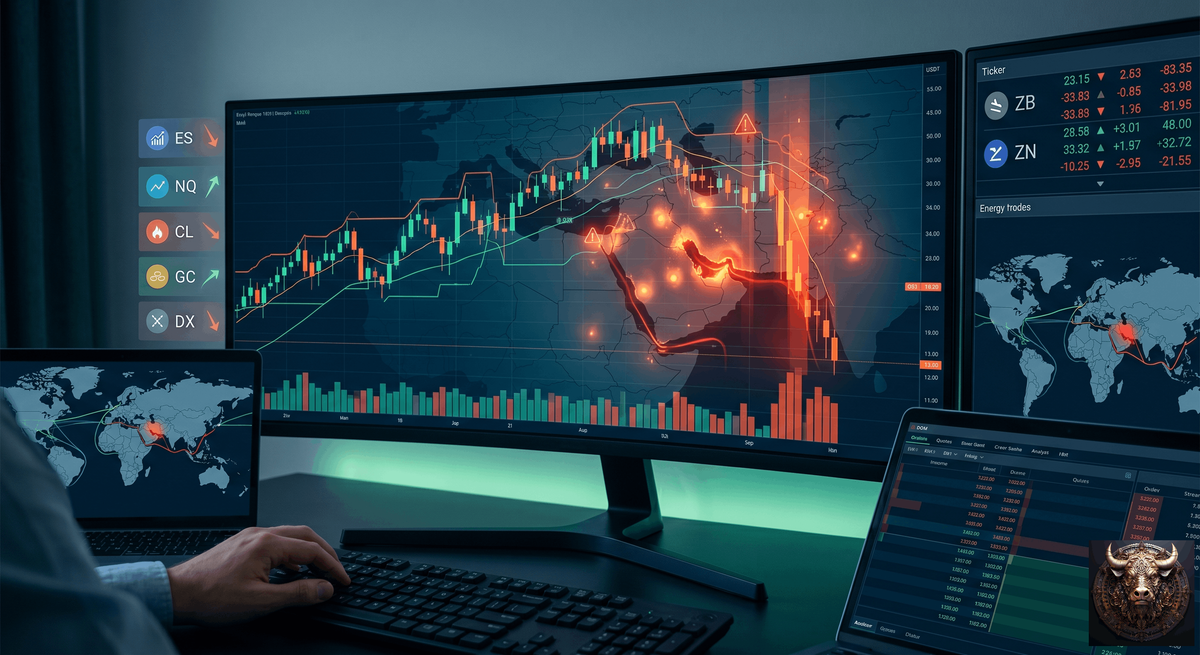
When geopolitical tensions escalate to the level of direct conflict involving major regional players like Iran, the market undergoes an immediate repricing of risk. This isn't about the moral or political implications; it's about the mechanical flow of capital. We are seeing a classic "flight to safety" rotation: capital drains out of high-beta tech and speculative equities and floods into gold (GC), the US Dollar (DX), and Treasuries (ZB/ZN).
Simultaneously, the risk premium on Crude Oil (CL) skyrockets. Because the Strait of Hormuz is a critical artery for global oil supply, the mere threat of disruption forces commercial hedgers and speculative funds to bid up crude.
But for a day trader, the core takeaway is this: event-driven markets are liquidity vacuums. When uncertainty is this high, large institutional market makers widen their quotes and pull resting orders. The result is thinner books, larger gaps between bid and ask, and explosive, whippy moves that can blow through your normal stop-losses in milliseconds.
Why Geopolitical Escalation Matters to an Index Trader
You might not trade oil or gold directly, so why does an escalating conflict matter for your NQ or ES trades? Three specific reasons.
1. Volatility expansion breaks your normal sizing
When the VIX spikes, the daily ranges on ES and NQ double or triple. If you are trading the same position size with the same tight stop you used during a quiet summer session, you are mathematically guaranteeing you will get chopped to pieces. Wider ranges require wider stops, and wider stops require smaller size.
2. Algorithmic headline trading takes over
During a geopolitical crisis, human discretionary traders step back, and algorithmic news-parsing bots step up. These algos scan breaking headlines and fire market orders instantly. This creates sudden, violent spikes or drops that have zero respect for your traditional technical support and resistance levels. A bullish flag pattern means nothing if a breaking headline about a missile strike hits the wire.
3. Cross-market correlations decouple
Usually, you might see the S&P 500 (ES) and Nasdaq 100 (NQ) move in lockstep. During an oil-driven geopolitical shock, that correlation can break. Energy sector heavyweights might prop up the ES, while the NQ gets hammered by rising bond yields. If you are trading off assumed correlations this week, you are trading a trap.
What to actually watch this week
If you trade the CME complex, here is your practical checklist for the upcoming sessions:
- The Overnight Gaps: Conflict escalations usually happen overnight during Asian or European sessions. Expect massive gap-ups or gap-downs at the 9:30 AM EST cash open. Do not blindly fade the gap. In crisis markets, gaps often run instead of filling.
- The CL to ES Inverse Relationship: Keep Crude Oil (CL) on a side monitor. If you see a sudden, violent spike in crude, expect an immediate downside reaction in ES and NQ as inflation and supply-chain fears get priced in.
- Order Flow Absorption: Look for where the massive algorithmic selling actually stops. Don't try to catch falling knives; wait for the tape to show absorption at a key level before stepping in.
The part nobody selling you a "Crisis Play" will say out loud
The blow-up point in event trading is rarely the thesis—it's the structure. Plunging liquidity, headline-driven algorithms, and massive overnight gaps are what take retail traders out, not being wrong about whether the market is bearish. You can be completely right that the market will sell off, and still get stopped out three times on the way down because you mistook a liquidity event for a clean trend.
Your edge during a geopolitical crisis is not predicting what a foreign government will do next. It is reading the order flow in the instrument you actually trade, respecting that volatility is elevated, and refusing to let panic pull you off your trading plan. That is the entire PriceIsKing thesis in one sentence: mechanics over hype.
The traders who survive and profit during weeks like this aren't the ones glued to cable news. They are the ones tracking their execution, sizing down, and letting the tape confirm before they commit.
Geopolitical escalation is a spectacle. Your job is to treat it like any other high-volatility session: a structure to be read, not a story to be believed. Keep your stops respected, size down, and trade the tape in front of you.
Disclaimer: The content on this site is intended for educational purposes only and should not be considered personalized investment, financial, or legal advice.
Futures, foreign currency and options trading contains substantial risk and is not for every investor. An investor could potentially lose all or more than the initial investment. Risk capital is money that can be lost without jeopardizing ones financial security or lifestyle. Only risk capital should be used for trading and only those with sufficient risk capital should consider trading. Past performance is not necessarily indicative of future results.