
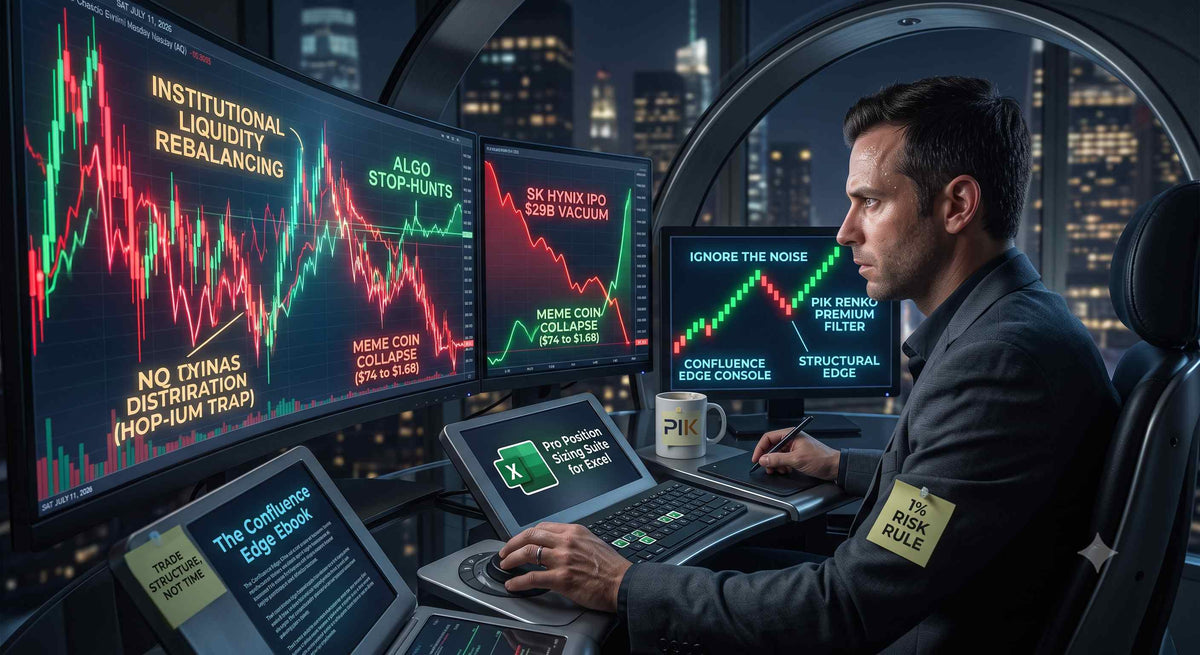
It is officially the summer of 2026, and the financial markets have just delivered one of the most ruthless, spectacular, and utterly predictable wealth transfers in modern history. According to a newly released report from The New York Times, nearly one million retail investors who bought into President Donald Trump’s various cryptocurrency ventures are currently sitting on a collective loss of $3.81 billion. Meanwhile, a federal disclosure filing revealed that Trump himself locked in roughly $1.2 billion in profits from those exact same ventures. His companies pulled in over $500 million from selling "governance tokens" via World Liberty Financial, and another $600 million from "meme" coins stamped with his face via CIC Digital LLC. The meme coin, which saw a euphoric spike to over $74 shortly after launch, has since violently crashed to around $1.68, obliterating the portfolios of those who bought the top. If you are looking at these numbers and wondering how it is mathematically possible for a founder to walk away a billionaire while his own supporters lose everything, you are about to get a masterclass in market liquidity. Retail investors essentially crowd-funded a $1.2 billion payday because they traded blind loyalty instead of structural reality.
Quick Answer Founders make billions while retail loses everything due to tokenomics and liquidity extraction. Insiders hold massive, zero-cost token allocations and use retail "hopium" as exit liquidity. To survive news-driven asset bubbles, traders must abandon emotional bias and rely on strict position sizing, structural confluence, and professional charting filters to avoid becoming the bag-holder.
How does the brutal mathematics of a $1.2 billion insider payday actually work?
The $3.8 billion loss absorbed by retail investors wasn't an accident; it was a mathematical certainty baked directly into the mechanics of celebrity cryptocurrency. To understand how a founder can extract over a billion dollars in profit while a million followers lose their life savings, you have to understand the brutal reality of "Automated Market Makers" (AMMs) and tokenomics.
When a meme coin or a governance token is launched, it has absolutely no intrinsic underlying value. It does not generate revenue, it does not pay a dividend, and it does not represent a physical commodity. The creator mints the total supply of the token out of thin air for fractions of a penny. The creator then retains a massive portion of that supply—often 20% to 50%—in insider wallets. At this exact moment, the token is technically worthless. It only gains financial value when a "liquidity pool" is established.
This is where the marketing machine kicks in. By leveraging massive celebrity influence and political loyalty, the founders drive a tidal wave of retail buyers to the exchange. These retail buyers bring real, hard-earned capital (like U.S. Dollars or Ethereum) and dump it into the liquidity pool to purchase the tokens. Because the supply of tokens is relatively fixed in the pool, this massive influx of real money causes the price of the token to skyrocket—in this case, sending the Trump meme coin spiking to an irrational $74 per coin.
Now, the trap is set. The retail buyers are looking at their portfolio apps, seeing massive "unrealized" gains, and experiencing intense euphoria. But those gains are completely illusory. There is not enough actual cash in the liquidity pool for everyone to cash out at $74. The only way you can turn your token back into real money is if someone else comes along and buys it from you at that price. It is the ultimate game of financial musical chairs.
The founder, who holds hundreds of millions of zero-cost tokens, doesn't wait for the music to stop. While the retail crowd is holding on for dear life and screaming "to the moon," the insider wallets slowly and systematically begin selling their massive supply into the liquidity pool. Every time they sell, they are extracting the real dollars that the retail crowd just deposited. By the time the founder has extracted $1.2 billion in hard cash, the liquidity pool is drained. The price violently collapses back down to $1.68, and the million retail investors are left holding digital tokens that nobody else wants to buy. They provided the exit liquidity. They bought the hype, and the insiders bought the mansions.
Why does "Hopium" and emotional bias destroy otherwise rational people?
If you look at the demographics of the people who lost that $3.8 billion, they aren't all naive teenagers. Many of them are successful professionals, business owners, and otherwise rational adults. So why did they abandon every fundamental rule of finance to buy a digital souvenir coin at $74?
The answer is the most dangerous drug in the financial markets: emotional bias. When you mix political loyalty, celebrity worship, or tribalism into a financial asset, the logical processing center of the brain completely shuts down. The investors who bought the Trump tokens weren't looking at the total addressable market, the circulating supply, or the order book depth. They were buying an identity. They believed that by holding the token, they were supporting a movement.
The market, however, is a cold, emotionless, sociopathic mechanism. It does not care who you voted for. It does not care what your favorite influencer tweeted. The market only respects the laws of supply and demand. When you trade based on "hopium"—the desperate hope that an asset will go up simply because you want it to—you are willingly walking into the slaughterhouse. You ignore the massive red flags, like the fact that the token's whitepaper literally states it offers "no ownership stake" and is "difficult to value". You hold onto a losing position because selling would feel like a betrayal of your political identity. This exact psychological blind spot is what institutional algorithms and insiders prey upon to extract wealth from the working class.
How could the Pro Position Sizing Suite for Excel have prevented a $3.8 billion disaster?
Let’s run a hypothetical scenario. Imagine if, before any of those one million investors were allowed to buy a single governance token, they were forced to run their trade idea through the Pro Position Sizing Suite for Excel. The outcome would have been radically different.
The vast majority of retail wipeouts happen because traders go "all in." They see a coin pumping, they experience intense Fear Of Missing Out (FOMO), and they dump their entire net worth into the asset at the absolute peak. They do not have an invalidation point. They do not have a stop-loss. They just close their eyes and pray.
The Pro Position Sizing Suite acts as a physical barrier between your emotions and your capital. If a trader used this spreadsheet, they would have been forced to manually input their total account equity and set a strict risk parameter—say, 1% or 2% of their total capital. They would have to look at the chart, identify a logical structural support level, and input the distance to their stop-loss.
Because the meme coin was experiencing wildly irrational volatility, the structural stop-loss would have been incredibly wide. When the Excel suite processed that wide stop-loss against a strict 1% account risk limit, the output would have told the trader to buy a fractionally small number of coins. It would have mathematically prevented them from over-leveraging. If the trade failed and the coin crashed to $1.68, the trader would have lost 1% of their account, shrugged it off as a bad trade, and lived to trade another day. The $3.8 billion loss only exists because retail traders refuse to use professional risk architecture.
Filtering out the celebrity noise: The Confluence Edge Ebook approach
If you want to stop being the mark at the poker table, you have to fundamentally change how you validate a trade entry. You cannot buy an asset because of a YouTube thumbnail, a political rally, or a Discord alert. You must demand objective, technical proof from the market itself. This is the exact framework detailed in The Confluence Edge Ebook.
Confluence is the practice of stacking independent, uncorrelated technical factors to build a bulletproof case for a trade. Let's apply the Confluence Edge framework to a celebrity pump-and-dump. A novice trader sees the coin going up 50% in an hour and buys. A confluence trader looks at the same chart and starts checking boxes.
Is price pulling back to a verified, historical structural support level? No, it is in parabolic price discovery. Is the volume profile indicating heavy institutional accumulation? No, the volume is purely retail panic-buying. Is there a defined, low-risk invalidation point? No, the nearest structural support is 80% below the current price.
Because the asset fails to achieve structural confluence, the professional trader completely ignores the hype and skips the trade. The Confluence Edge Ebook teaches you how to become completely immune to FOMO by giving you a rigid, unyielding checklist. If the market cannot provide the required technical evidence, your capital stays safely in your account. You learn to let the amateurs chase the shiny objects while you wait patiently for high-probability, structurally sound setups.
How NinjaTrader 8 and PIK Renko Premium prevent you from being exit liquidity
When a highly manipulated asset is in the final stages of a distribution cycle (the phase where insiders are dumping their bags on retail), the time-based charts look incredibly deceiving. If you are watching a 1-minute or 5-minute candlestick chart on a basic web-broker platform, the insiders will intentionally paint large, sudden green candles. These "bull traps" are designed to trick retail momentum traders into thinking a second massive rally is starting, drawing in fresh liquidity for the insiders to sell into.
To survive this predatory environment, you must upgrade your visual data feed. Serious speculators operate on NinjaTrader 8 because it allows you to completely remove time from the equation. When you pair NT8's powerful processing engine with the PIK Renko Premium indicator, you strip the insiders of their greatest weapon: chart manipulation.
Renko charts only print a new brick when a specific, pre-determined price threshold is breached. If an insider tries to paint a fake 5-minute green candle with low volume to induce FOMO, but fails to break the actual structural price resistance, the PIK Renko chart will literally do nothing. It will remain flat and red. It visually forces you to see the underlying weakness of the trend.
While the retail crowd is hyperventilating over the flashing lights of a 1-minute time chart, the PIK Renko trader is calmly watching a slow, deliberate staircase of red bricks form, explicitly confirming that the asset is in a death spiral. By filtering out the time-based noise, you gain the clarity required to either confidently short the backside of the momentum or simply grab some popcorn and watch the collapse from the sidelines.
The Ultimate Lesson: The market does not care who you voted for
The catastrophic $3.8 billion loss suffered by the million Trump crypto investors is a grim, historical monument to the dangers of emotional trading. The financial markets are the ultimate equalizer. They do not care about your political affiliation, your social media following, or your belief system. The tape is entirely agnostic.
If you continually substitute blind faith for risk management, the market will eventually find you, and it will forcefully separate you from your capital to feed the insiders. The only way to survive and thrive as an independent trader is to build an impenetrable wall of logic around your portfolio. You must track every dollar using tools like the Pro Position Sizing Suite. You must demand absolute technical perfection using the rules of The Confluence Edge. And you must filter out the deceptive noise of the crowd using advanced indicators like PIK Renko Premium on a professional platform like NinjaTrader 8.
Stop letting charismatic founders and Twitter hype cycles dictate your financial future. Become the casino, not the gambler. Structure your edge, calculate your risk, and let the math do the heavy lifting.
Frequently Asked Questions
What is a cryptocurrency liquidity pool and how does it trap retail traders?
A liquidity pool is a smart contract where tokens are traded against real assets like U.S. Dollars or Ethereum. Founders trap retail traders by holding massive pre-mined token allocations; when retail buyers pump real money into the pool to buy the hype, founders sell their free tokens, draining the real cash and leaving retail with worthless digital assets.
Why did the Trump meme coin crash from $74 to under $2?
The coin crashed because it lacked intrinsic value and operated purely on social momentum. Once the early insiders and founders began aggressively taking profits and selling their massive holdings into the market, the buying pressure from retail investors was completely overwhelmed, causing a catastrophic price collapse.
How does the Pro Position Sizing Suite prevent catastrophic account losses?
The Excel suite mathematically prevents traders from over-leveraging by forcing them to define a strict risk percentage and a hard stop-loss before execution. It calculates exactly how small the position size must be to ensure that even if the trade goes to zero, the overall account only suffers a minor, manageable drawdown.
What is structural confluence in day trading?
Structural confluence is the strategy of waiting for multiple, independent technical factors—such as key support/resistance levels, order flow imbalances, and specific price-action patterns—to perfectly align before taking a trade, thereby filtering out impulsive, news-driven hype entries.
Why are Renko charts better than time-based charts for volatile assets?
Time-based charts often print deceptive "bull trap" wicks designed to induce FOMO during volatile events. Renko charts ignore time entirely, only printing new visual bricks when significant structural price thresholds are broken, which filters out the noise and reveals the true directional trend.
Can I use NinjaTrader 8 to trade cryptocurrencies?
NinjaTrader 8 is primarily a professional futures and forex trading platform. While it is the gold standard for analyzing and trading regulated CME index, energy, and metals futures using custom indicators like PIK Renko Premium, it is generally not used for trading unregulated offshore altcoins.