
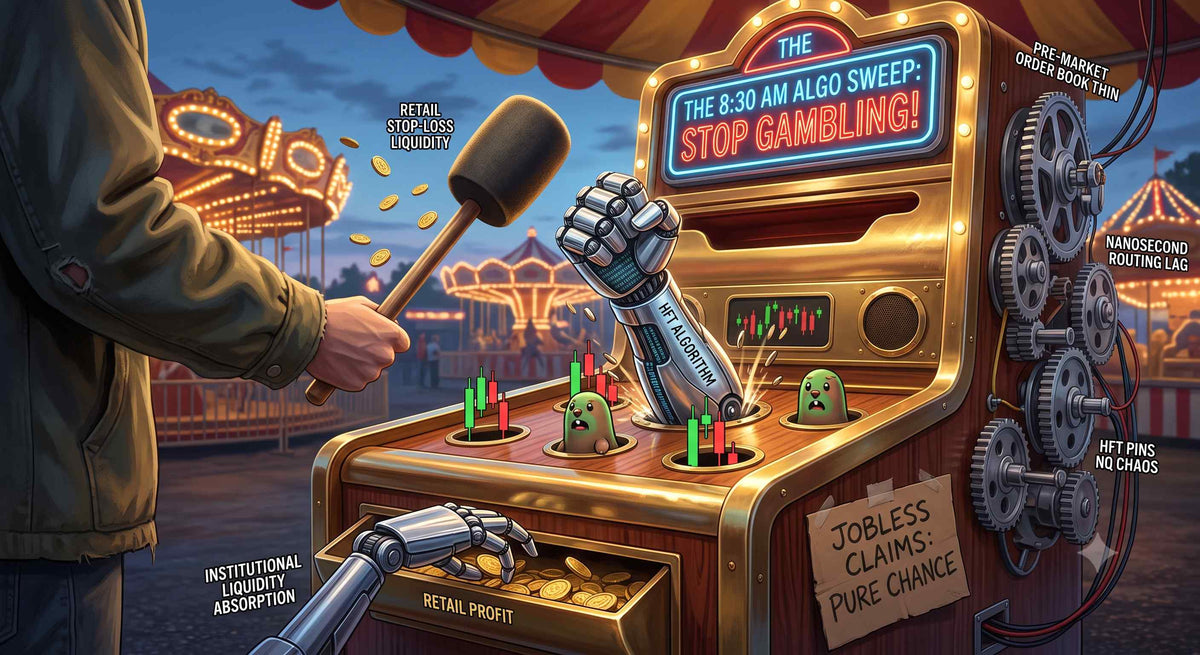
Good morning, and welcome to Thursday, July 16, 2026. It is exactly 8:29 AM EST. Across the globe, thousands of retail day traders are sitting in their pajamas, clutching their third cup of coffee, and staring unblinking at their E-mini Nasdaq (NQ) charts. They have their fingers hovering over their mouse buttons, ready to play the weekly game of macroeconomic roulette known as the Initial Jobless Claims release. At precisely 8:30:00 AM, the Department of Labor drops a single, boring spreadsheet onto the internet. Within milliseconds, the NQ violently spikes 40 points to the upside, triggering a euphoric rush of retail buy orders, before instantly collapsing 80 points in the opposite direction. By 8:30:15 AM, the dust settles, the chat rooms go dead silent, and half the retail traders in the market have just blown their daily drawdown limit before the New York opening bell has even rung. If you are treating the 8:30 AM data drop like a slot machine, hoping to catch a magical 100-point runner so you can close your laptop and go play golf by 9:00 AM, you are fundamentally misunderstanding how modern financial markets operate. You are not trading; you are blindly volunteering to be pre-market exit liquidity for institutional algorithms.
Quick Answer The 8:30 AM Initial Jobless Claims release triggers extreme algorithmic volatility in a low-liquidity pre-market environment. High-frequency algorithms use the data spike to violently sweep retail stop-losses in both directions. Professional day traders avoid this chaotic 8:30 AM gamble, utilizing rigid position sizing and waiting for the structural 9:30 AM open to execute safe, confluence-based setups.
Why does a boring jobs report trigger absolute algorithmic chaos?
To understand why the chart looks like an electrocardiogram of a heart attack at exactly 8:30 AM, you have to understand who you are actually trading against. You are not trading against human beings. You are competing against high-frequency trading (HFT) firms whose servers are physically co-located inside the exchange data centers.
When the Initial Jobless Claims number is published, human analysts do not sit down, read the PDF, and slowly decide if the macroeconomic environment is bullish or bearish. Instead, natural language processing (NLP) algorithms parse the raw JSON data feed in microseconds. They instantly compare the actual reported number against the Wall Street consensus estimate. If the number deviates by even a fraction of a percent, these servers execute thousands of automated futures contracts before the pixels on your retail trading monitor have even refreshed to show you the 8:30 AM candlestick.
You cannot out-click a machine that measures its database query latency in nanoseconds. When you try to hit the "buy market" button as the news drops, your order is subjected to severe retail routing lag. By the time your order actually hits the exchange, the algorithms have already driven the price up 40 points. You end up getting filled at the absolute pinnacle of the spike, right as the HFTs are taking their profits and reversing the momentum.
The Pre-Market Liquidity Sweep: How HFTs actively hunt your stops
The danger of the 8:30 AM release is amplified by the environment in which it occurs. At 8:30 AM EST, the regular equity session is still an hour away from opening. Because the major index ETF providers and traditional mutual funds are not actively transacting, the futures order book is incredibly thin.
In a thin order book, there are very few limit orders resting on the bid and the ask. This lack of liquidity means that a relatively small volume of market orders can push the price incredibly far, incredibly fast. This is exactly what the smart money wants. The algorithms use the Jobless Claims catalyst to initiate a "liquidity sweep."
They know exactly where retail traders have placed their pre-market stop-losses (usually just above the overnight high or just below the overnight low). The algos will intentionally flood the thin order book with aggressive volume in one direction to push the price past those obvious support or resistance levels. Once your stop-loss is triggered, your broker automatically executes a market order to close your position. That forced retail execution provides the exact influx of liquidity the algorithms need to fill their massive institutional block orders at premium prices. Once the stops are swept and the liquidity is absorbed, the market aggressively reverses. This is why you get "wicked out" of a perfectly good trade at 8:30 AM, only to watch the market eventually go in your intended direction at 9:45 AM.
Why the 8:30 AM gamble is a statistical death sentence
There is a toxic fantasy sold on social media that day trading is about catching a 100-point pre-market runner from your phone while drinking a smoothie on the beach. This leads amateur traders to treat major macroeconomic data drops like lottery tickets. They enter full-sized positions at 8:29 AM, set a tight stop-loss, and pray they guessed the right direction.
Let's break down the sheer statistical absurdity of this approach. First, you are guessing the outcome of the economic data. Second, even if you guess the data correctly, you are guessing how the algorithms will interpret that data (sometimes bad news is good news for equities, and vice versa). Third, because the pre-market order book is so thin, you will suffer catastrophic slippage. A 10-point stop-loss can instantly turn into a 30-point actual loss because there are no buyers at your intended exit price.
You are stacking negative probabilities on top of negative probabilities. When you gamble on the 8:30 AM news, you are removing all technical structure, all volume profiling, and all logical risk-to-reward metrics from your business. You are simply closing your eyes and throwing darts in a dark room against a supercomputer. Over a timeline of 100 trades, this strategy has a 100% mathematical guarantee of blowing your account to zero.
Locking down your risk: The Pro Position Sizing Suite defense
If you are suffering from extreme market addiction and absolutely refuse to sit on your hands during the pre-market session, you must at least handcuff your own destructive tendencies. If you are going to navigate the chaotic volatility of an 8:30 AM data drop, you cannot manually guess your contract size. You need a cold, mathematical circuit breaker.
This is the exact operational environment where the Pro Position Sizing Suite for Excel stops you from ruining your week. During high-impact news events, the Average True Range (ATR) of the market expands violently. To avoid getting swept by a random algorithmic wick, you are forced to place your structural stop-loss much further away from your entry price than you normally would.
If you widen your stop-loss but maintain your normal contract size, you are instantly violating your risk parameters. The Excel suite prevents this fatal error. By forcing you to input your exact entry and your necessarily wide pre-market stop-loss, the spreadsheet instantly calculates your trade against a strict 1% maximum account risk rule. Because the stop distance is huge, the suite will aggressively scale your position size down—often forcing you to trade a single Micro contract (MNQ) instead of your usual E-mini size. It mathematically guarantees that when the 8:30 AM algorithmic sweep inevitably hunts your stop-loss, the financial damage to your account is entirely superficial. It protects you from your own ego.
Waiting for the 9:30 AM Open: The Confluence Edge approach
Real professional day traders do not care about being first; they care about being right. The secret to surviving Thursday mornings is surprisingly simple: walk away from your desk at 8:25 AM. Go make breakfast. Let the machines fight each other. Let the algorithms sweep the retail stops, widen the spreads, and digest the macroeconomic data.
When you return to your screens at 9:15 AM, the true narrative of the day has usually been established. The chaotic wicks have printed, and the market has tipped its hand. Now, you wait for the 9:30 AM New York opening bell to bring genuine, thick institutional volume back into the order book. This is where you apply the rigid, structured framework detailed in The Confluence Edge Ebook.
Instead of guessing the news direction, you demand proof from the chart. You look for structural confluence. Did the 8:30 AM news spike create a massive volume imbalance? Is the price now pulling back to perfectly test that institutional volume node while simultaneously touching the daily VWAP? Is your non-time-based indicator (like the PIK Renko Premium) signaling a clean shift in momentum?
When you wait for multiple independent technical factors to align *after* the news has settled, you transition from gambling to operating a high-probability business. The Confluence Edge teaches you to ignore the terrifying headlines and focus exclusively on where the smart money is actually deploying their capital post-news.
Reclaiming your morning routine
Stop letting a spreadsheet from the Department of Labor dictate your emotional state at 8:30 in the morning. The financial markets are specifically designed to transfer wealth from the impatient to the patient. Every time you smash the market-buy button during a pre-market news spike, you are handing your capital directly over to a server rack in New Jersey.
Protect your capital. Run your risk architecture through the Pro Position Sizing Suite before you ever touch your broker platform. Let the amateur retail crowd get chopped to pieces by the morning algorithms. Wait for the 9:30 AM volume, look for structural confluence, and execute like a professional. The market will always give you a cleaner, safer setup if you just have the discipline to wait an extra sixty minutes.
Frequently Asked Questions
Why does the market react so violently at exactly 8:30 AM EST?
At 8:30 AM EST on Thursdays, the US government releases critical macroeconomic data like Initial Jobless Claims or CPI. High-frequency trading (HFT) algorithms instantly parse this data and execute massive orders in milliseconds, causing violent, instantaneous price spikes.
What is a pre-market algorithmic liquidity sweep?
Because pre-market order books are thin, institutions use news catalysts to rapidly drive prices past obvious support or resistance levels. This intentionally triggers retail stop-losses, creating a sudden flood of available liquidity that institutions use to fill their large block orders at better prices.
Why is trading the news considered gambling for retail traders?
Retail traders face immense latency disadvantages compared to co-located institutional servers. By the time a human clicks a button based on a news headline, the initial algorithmic move is already over. The retail trader usually gets filled at the exact moment the algorithms reverse the market, resulting in immediate losses.
How does the Pro Position Sizing Suite for Excel handle pre-market volatility?
Pre-market volatility requires placing wider structural stop-losses to avoid getting wicked out. The Excel suite automatically calculates this wider stop distance against your strict 1% account risk limit, mathematically forcing you to reduce your contract size so a failed trade doesn't blow your account.
What does it mean to trade "structural confluence" after the news?
Instead of guessing the immediate reaction to a news event, structural confluence involves waiting for the volatility to settle. You then execute a trade only when multiple technical factors—such as volume nodes, VWAP, and pure price action—align perfectly to confirm the true institutional trend.
Why should day traders wait for the 9:30 AM EST market open?
At 9:30 AM EST, traditional equity markets open, bringing massive, genuine institutional volume into the order book. This thicker liquidity stabilizes the bid-ask spread and smooths out price action, providing much cleaner and more predictable technical setups compared to the chaotic pre-market chop.