
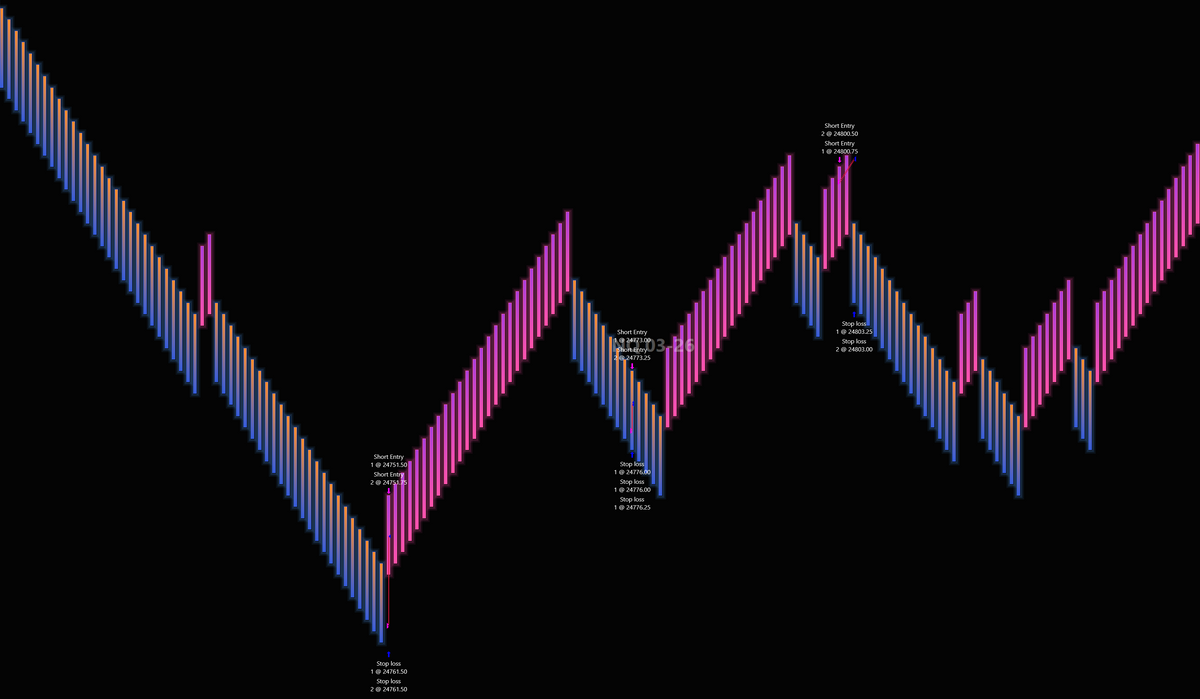
Renko Charts Strip Out the Noise — But Only If You Set Them Up Right
By Sut P
Renko charts promise the one thing every futures trader wants: a clean read on trend with the chop stripped out. But most traders bolt a default Renko onto a chart, never touch the settings, and then wonder why it lags or flips at the worst possible moment. The bricks aren't the problem. The setup is. Here's what's actually happening under the hood — and how to make a Renko chart work for the way you trade.
What a Renko chart actually does
A normal candlestick chart prints a bar every time interval — every minute, every five minutes — whether price moved or not. That means most of what you're staring at is time, not movement. Renko throws time out. A new brick prints only when price travels a fixed distance, so a quiet hour might produce two bricks and a violent one might produce twenty. The result is a chart that ignores the sideways grind and draws trend as a clean staircase.
That's the appeal. The catch is that "a fixed distance" is a decision you have to make — and it changes everything downstream.
The two numbers that define your chart
Modern Renko isn't one setting. The good implementations give you two, and understanding them is the difference between a chart that helps and one that whipsaws.
Brick Size is the height of every brick, measured in ticks. Bigger bricks mean fewer of them — a smoother chart that lags more. Smaller bricks mean more of them — faster signals, more noise. There's no universally correct number; it scales to the instrument and your timeframe. On MNQ, a scalper and a swing trader will run completely different brick sizes on the exact same product.
Trend Threshold is the quieter — and more important — one. It sets how far price has to push in the trend's direction to print the next continuation brick, and from it the reversal distance is derived automatically. Set the threshold tight and your chart flips on every minor pullback. Set it wider and small counter-moves get absorbed into the trend instead of breaking it. This single number is your noise filter, and it's the one most traders never touch.
A rule of thumb worth taping to your monitor: keep Brick Size larger than the Trend Threshold, and make it a clean multiple — 8/4, 15/5, 20/5. That keeps every brick the same height and your reversals honest.
The honest part nobody mentions
Here's what most indicator sellers gloss over: the current brick repaints. That isn't a bug — it's the definition of Renko. The brick on the right edge of your chart is still forming, and it updates as price moves until it completes the threshold. Completed bricks lock and never change; the live one is an estimate.
Why does that matter? Because a strategy backtested on completed Renko bricks can look flawless and then fall apart live — because in real time you're trading the forming brick, not the finished one. If you automate on Renko, test on live or replay data, never just historical bars. This is the same idea we apply to everything at PriceIsKing: respect the mechanics, and the hype takes care of itself.
Three setups that make Renko look "broken"
- A brick size that doesn't fit the instrument. Copying someone's 4-tick setup onto a different product or timeframe is how you end up with a chart that's either a wall of bricks or barely moves.
- A trend threshold left on default. If your Renko flips on every wiggle, you haven't widened the threshold to filter the noise you were trying to remove in the first place.
- Judging it on the forming brick. The right-edge brick is a live estimate. Treating it as a confirmed signal is the single most common Renko mistake.
Why the look isn't just vanity
It's tempting to dismiss chart aesthetics as ego. It isn't. You stare at this thing for hours, and the speed at which your eye separates trend from reversal is a real, measurable edge. A flat, low-contrast brick forces your brain to work on every glance. A clean, high-contrast brick with a crisp edge does the reading for you.
The bricks were never the hard part. The setup is.
That's exactly why we built PIK Renko Premium the way we did. Under the hood it runs the same uniform-brick, trend-threshold math described above — Brick Size and Trend Threshold, with the reversal distance derived for you so every body stays equal. On top of that sits a hardware-accelerated rendering layer with twenty hand-tuned themes, an optional glow engine, real high/low wicks, and independent control over brick width and the gap between bricks. You set the math once, then make the chart look exactly how your eye wants it — institutional and muted, or neon and glowing — from a single dropdown.
The takeaway
Renko is one of the most misunderstood chart types in retail trading. People expect a magic noise filter, then blame the bricks when it whipsaws — when the real culprit is a brick size that doesn't fit the instrument and a trend threshold left on default. Get those two numbers right, respect that the forming brick is an estimate, and Renko becomes exactly what it promises: a clean, honest read on trend with the chop removed.
Dial it in, make it readable, and let the staircase do the work. If you want a Renko bar type that handles the math and the look in one place, take a look at PIK Renko Premium for NinjaTrader 8.
📥 Get Premium Renko Bar
Click below to access premium renko bar files ready to import into NinjaTrader 8:
📥 Get Market Replay Data
Need high-quality historical data? Click below to access premium Market Replay data files ready to import into NinjaTrader 8:
This article is for educational purposes only and is not financial, investment, or trading advice. PIK Renko Premium is a charting and visualization tool that does not generate buy or sell signals. Futures trading carries substantial risk of loss and is not suitable for every investor. Past performance and any examples shown are not indicative of future results. PIK Renko Premium is a product of Vulture Data Solutions Inc. / PriceIsKing.com and is not affiliated with or endorsed by NinjaTrader. Do your own research and consult a licensed professional before making any trading decision.